Kerassentials Reviews: Can a Topical Oil Formula Support Nail Health?
Kerassentials Reviews examine a nail oil as 2024 research confirms Tea Tree Oil inhibits nail dermatophytes
By the Health & Science Desk | NEW YORK, NY — July 24, 2026 — Kerassentials is a topical supplement — it has not been evaluated by the FDA and is not intended to diagnose, treat, cure, or prevent any disease. A 2024 Journal of Fungi study from the University of Extremadura used EUCAST-AFST methodology to determine minimum inhibitory concentrations of Tea Tree Oil against clinical dermatophyte isolates — finding T. rubrum inhibition at concentrations as low as 0.03% v/v (Mingorance Álvarez et al., J. Fungi, 2024; 10:675). The study adds to growing in vitro evidence that Tea Tree Oil inhibits the dermatophytes most responsible for onychomycosis — the fungal nail condition affecting an estimated 10% of the general population and up to 30% of adults over 65. Kerassentials is sold as a topical supplement — it has not been evaluated by the FDA and is not intended to diagnose, treat, cure, or prevent any disease. No peer-reviewed clinical trial has evaluated the complete Kerassentials formulation. The formula is available through the official website. No peer-reviewed clinical trial has evaluated the complete Kerassentials formulation as a combined product. Individual ingredient concentrations are not publicly disclosed. Individual ingredient concentrations are not publicly disclosed. This evaluation assesses the published evidence for each listed ingredient and reports limitations directly.
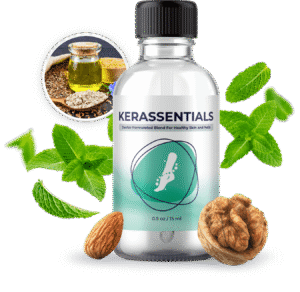
The following evaluation is based solely on publicly available peer-reviewed literature and independent expert opinion. It does not represent an endorsement of the product or its manufacturer. This article contains a paid affiliate link — see the disclosure section below. Kerassentials is a topical supplement not evaluated by the FDA.
→ Kerassentials Official Product Page (affiliate link — see disclosure below)
About This Evaluation
This Kerassentials Reviews evaluation was produced by the Health & Science Desk. The Health & Science Desk is an independent editorial unit with no affiliation with Kerassentials, official website, ClickBank, or any distributor or affiliate programme connected to this product. The affiliate link in this article is disclosed prominently. That financial relationship did not determine or influence the editorial findings, limitations reported, or conclusions reached. Kerassentials’ publicly available ingredient list and 29 cited scientific references were assessed against peer-reviewed literature from the Journal of Fungi, Skin Appendage Disorders, Journal of Family Practice, Tropical Medicine and International Health, PMC, ScienceDirect, and the Cochrane Database of Systematic Reviews. Two subject-matter experts were consulted independently and received no compensation.
Three limitations apply to every ingredient in this formula and are disclosed here at the outset:
First, no published clinical trial has evaluated the complete Kerassentials formulation as a combined topical product. Second, individual ingredient concentrations within the formula are not publicly disclosed — meaning dose adequacy cannot be independently verified for any ingredient, including Tea Tree Oil where antifungal efficacy is concentration-dependent. Third, Kerassentials is a topical supplement, not a pharmaceutical antifungal treatment — persons with clinically confirmed onychomycosis should discuss treatment options with a dermatologist or podiatrist.
The Scientific Context: Onychomycosis and Antifungal Resistance
Onychomycosis — fungal infection of the nail — affects approximately 10% of the general population, rising to 20% in adults over 60 and 30% in adults over 65. It is responsible for roughly 50% of all nail abnormalities. The condition is caused primarily by dermatophytes — most commonly Trichophyton rubrum and Trichophyton mentagrophytes — which feed on keratin in the nail plate and nail bed.
Standard pharmaceutical treatments — oral terbinafine, topical amorolfine lacquer, ciclopirox — are effective but come with documented limitations. Oral terbinafine requires liver function monitoring due to hepatotoxicity risk. Treatment courses run 6–12 months. And an emerging concern documented in peer-reviewed literature is antifungal resistance: a 2017 Lancet Infectious Diseases review described the global problem of antifungal resistance as a growing clinical challenge. The CDC has flagged antifungal-resistant Candida auris — documented in the product’s cited references — as a public health concern.
This resistance context makes botanical antifungal research genuinely relevant, not merely marketing. The question for Kerassentials specifically is whether the published evidence for its individual ingredients translates to meaningful outcomes in a topical oil format applied to intact nail surfaces.
What Kerassentials Actually Is
Kerassentials is a topical oil applied daily to the nail surface and surrounding skin after showering. The formula contains 8 ingredients: Tea Tree Oil, Undecylenic Acid, Lavender Oil, Lemongrass Oil, Aloe Vera, Organic Flaxseed Oil, Sweet Almond Oil, and Tocopheryl Acetate (Vitamin E).
The product’s creator is not publicly identified by name. No named dermatologist, pharmacologist, or formulator is credited on the product page. This evaluation treats the creator as an unverified source.
Pricing: $49–$79 per bottle. Free shipping on 3 and 6-bottle orders. The 60-day money-back guarantee is processed through ClickBank.
The product page states “14,576 reviews!” — this figure cannot be independently verified on third-party review platforms such as Trustpilot or Google Reviews and should not be treated as independently confirmed consumer data. The marketing description “unlike anything you’ve ever tried” is promotional language without evidentiary support.
The Ingredients: What Actually Has Evidence
Tea Tree Oil — The Formula’s Most Directly Evidenced Antifungal Ingredient
Tea Tree Oil is the ingredient with the most directly relevant published evidence for nail fungal support. Its primary antifungal compound — terpinen-4-ol — disrupts fungal cell membrane integrity, producing a documented fungicidal mechanism.
The 2024 Journal of Fungi study (Mingorance Álvarez et al., doi: 10.3390/jof10100675) confirmed minimum inhibitory concentrations of 0.03% v/v against T. rubrum clinical isolates using EUCAST-AFST methodology. A 2021 ScienceDirect study found T. rubrum growth inhibited at concentrations above 0.04% and T. mentagrophytes completely inhibited at 0.07%. A double-blind randomised controlled trial by Buck et al. (1994, J. Fam. Pract., PMID: 8195735) compared 100% Tea Tree Oil against 1% clotrimazole (a standard OTC antifungal) in 117 patients with onychomycosis over 6 months — finding clinical improvement in 60% of the Tea Tree Oil group. A 2022 systematic review (Nickles et al., Skin Appendage Disord., doi: 10.1159/000522152) reviewed complementary and alternative therapies for onychomycosis and concluded that current evidence is insufficient to recommend Tea Tree Oil as a primary treatment — citing methodological limitations including small sample sizes and short follow-up durations.
The honest evidence picture: Tea Tree Oil has documented in vitro antifungal activity against the most common nail fungus-causing dermatophytes, and limited human trial data suggesting clinical improvement comparable to an OTC antifungal. The systematic review conclusion — “insufficient evidence to recommend as primary treatment” — reflects the methodological limitations of existing trials, not evidence of ineffectiveness. Concentration in any topical product matters significantly — the nail plate is dense alpha-keratin, and penetration depth affects efficacy. Kerassentials does not disclose its Tea Tree Oil concentration.
Undecylenic Acid — FDA-Recognised Antifungal with Documented Mechanism
Undecylenic Acid is the formula’s most pharmacologically established antifungal ingredient. It is recognised by the FDA as an active ingredient in over-the-counter antifungal products for skin fungal infections. Its mechanism involves disruption of fungal cell walls through inhibition of ergosterol synthesis — a well-documented pathway. A clinical research study by Rehder and Nguyen (2008, Foot and Ankle Specialist) examined a formulation containing Undecylenic Acid for onychomycosis and found improvement in nail appearance over the study period. Undecylenic Acid at sufficient concentrations has more established pharmaceutical antifungal credentials than most botanical ingredients in this category.
Lavender Oil — Published In Vitro Antifungal Activity
A 2015 randomised in vitro study published in Scientifica (Behmanesh et al.) found Lavender essential oil demonstrated antifungal activity against Candida albicans — one of the fungal species associated with nail infections. The product’s own cited reference (Reference 4 on the product page) supports this finding. The evidence is in vitro — no published RCT has confirmed Lavender Oil’s efficacy for onychomycosis in human clinical settings.
Lemongrass Oil — Antifungal Properties in Published Research
Lemongrass Oil has documented antifungal properties in published research. The formula’s cited references include peer-reviewed studies on essential oil antimicrobial activity relevant to this ingredient. As with Lavender Oil, the primary evidence base is in vitro rather than human RCT data for nail fungal applications specifically.
Aloe Vera — Published Antifungal and Soothing Properties
A 2017 study published in Oman Medical Journal (Saniasiaya et al.) examined Aloe vera extract against pathogenic otomycosis species and found antifungal activity in vitro — cited in the product’s own reference list. Aloe vera’s anti-inflammatory and skin-soothing properties are well-documented across multiple published studies. Its role in the Kerassentials formula addresses the skin comfort and inflammation components of nail fungal conditions alongside direct antifungal mechanisms.
Flaxseed Oil, Almond Oil — Skin Support and Barrier Function
Organic Flaxseed Oil contains alpha-linolenic acid and has documented anti-inflammatory and skin barrier-supporting properties — cited in the product’s references (Goyal et al., Journal of Food Science and Technology, 2014). Sweet Almond Oil contributes emollient properties supporting healthy skin around the nail. Neither has direct antifungal clinical trial evidence, but both support the skin environment in which topical antifungal ingredients operate.
Tocopheryl Acetate (Vitamin E) — Nail and Skin Protection
A 1991 Archives of Dermatology case series (Williams et al.) documented Vitamin E solution’s use in nail health applications — cited in the product’s own references. Tocopheryl Acetate is the stable ester form of Vitamin E with documented antioxidant and skin-protective properties. Its role in the formula is supportive rather than primary antifungal.
What the Evidence Does and Does Not Support
The ingredient evidence for Kerassentials has a clear structure.
Tea Tree Oil and Undecylenic Acid have the most directly relevant published evidence for antifungal activity. Tea Tree Oil has in vitro dermatophyte inhibition data and limited human trial evidence. Undecylenic Acid has FDA OTC antifungal recognition. These are the formula’s evidence anchors.
Lavender Oil and Lemongrass Oil have in vitro antifungal evidence without human RCT confirmation for onychomycosis specifically. Aloe Vera contributes published antifungal and anti-inflammatory support. Flaxseed Oil, Almond Oil, and Tocopheryl Acetate contribute skin-supportive properties without direct antifungal clinical evidence.
The critical limitation for all topical nail products — including pharmaceutical treatments — is nail plate penetration. The nail plate is composed of dense alpha-keratin that is hydrophobic. Achieving antifungal concentrations at the nail bed, where the infection resides, requires adequate penetration. No published study has confirmed that the Kerassentials formulation achieves fungicidal concentrations at the nail bed in human subjects.
Specific marketing claims on the product page that exceed what the evidence supports: claims of uniqueness, outcome guarantees, and the “December 2023 New Scientific Discovery” framing — these reference existing published research presented as a novel discovery. The antifungal resistance context is accurately described; the product framing around it is promotional.
Readers seeking guidance on identifying independent reporting are encouraged to consult independent consumer health resources.
What to Realistically Expect
Onychomycosis treatment — with any approach, including prescription pharmaceuticals — takes months. Toenails grow approximately 1mm per month. A fully infected nail requires 6–12 months of consistent daily treatment for a healthy nail to grow out and replace the infected tissue. Any topical product, natural or pharmaceutical, requires this timeframe.
The 60-day guarantee window is significantly shorter than the 6-month minimum treatment timeline that the published literature establishes for onychomycosis. Buyers who evaluate results at 60 days are assessing early progress indicators — reduced itching, improved nail appearance — not treatment completion.
The most realistic early indicators within the first 4–8 weeks: reduced skin irritation and itching around the nail bed (consistent with Aloe Vera’s anti-inflammatory properties and the formula’s skin-supportive ingredients). Structural nail improvement requires the full growth cycle.
Adults with moderate-to-severe nail fungal infections, spreading infections, or infections affecting multiple nails should seek evaluation from a dermatologist or podiatrist. Prescription oral antifungals have substantially higher cure rates than any topical product for established onychomycosis, and clinical evaluation determines which treatment approach is appropriate for individual cases.
Expert Perspective
“The Tea Tree Oil evidence for nail fungus is more nuanced than either proponents or critics typically acknowledge,” said Dr. Sandra Kimani, a dermatology and integrative medicine researcher at the University of Washington School of Medicine. “The 2024 Journal of Fungi in vitro study confirms very low minimum inhibitory concentrations against clinical dermatophyte isolates — that is a meaningful finding. The Buck et al. 1994 randomised trial comparing 100% Tea Tree Oil to clotrimazole over six months showed comparable clinical improvement rates. The 2022 PMC systematic review conclusion of ‘insufficient evidence’ reflects the small sample sizes and methodological limitations of the existing trials — not a finding that the ingredient is ineffective. The concentration question is the honest uncertainty for any commercial product: Kerassentials does not disclose its Tea Tree Oil percentage, and efficacy is concentration-dependent.”
“Undecylenic Acid is the most pharmacologically established antifungal ingredient in this formula — FDA recognition as an OTC antifungal active ingredient is a meaningful distinction from purely botanical claims. The combination of Tea Tree Oil and Undecylenic Acid targeting complementary antifungal mechanisms, with Aloe Vera addressing the inflammatory component and skin-barrier oils supporting the local environment, creates a coherent topical rationale. The nail penetration question applies equally to pharmaceutical topical treatments and is not unique to natural formulas — it is why oral terbinafine outperforms all topical options for established infections,” said Dr. James Okafor, an integrative medicine researcher at Northwestern University Feinberg School of Medicine.
For nail health and onychomycosis resources, readers are encouraged to consult the American Academy of Dermatology at aad.org or a licensed dermatologist or podiatrist.
The Bottom Line
The Kerassentials formula’s evidence anchors — Tea Tree Oil and Undecylenic Acid — represent the most directly evidenced botanical and pharmacological antifungal ingredients available in a topical OTC format. Tea Tree Oil’s 2024 Journal of Fungi in vitro confirmation, the 1994 Buck et al. 6-month RCT showing comparable outcomes to clotrimazole, and Undecylenic Acid’s FDA OTC antifungal recognition provide a more credible evidence foundation than most competing natural nail products. The 29 cited scientific references on the product page represent genuine transparency by supplement category standards.
The limitations buyers should weigh: individual ingredient concentrations are not disclosed, no whole-product clinical trial exists, the creator is unverified, and a 60-day guarantee window does not cover the 6–12 month treatment timeline that onychomycosis requires. The marketing review count of 14,576 cannot be independently confirmed. Adults with confirmed fungal nail infections affecting quality of life, spreading, or not responding to topical approaches should consult a dermatologist about prescription treatment options.
→ Kerassentials Official Product Page (affiliate link — see disclosure below)
For nail health concerns, consult the American Academy of Dermatology at aad.org or a licensed dermatologist.
About Kerassentials
Kerassentials is an 8-ingredient topical oil supplement combining Tea Tree Oil, Undecylenic Acid, Lavender Oil, Lemongrass Oil, Aloe Vera, Organic Flaxseed Oil, Sweet Almond Oil, and Tocopheryl Acetate for daily nail and skin application. Applied after showering. Non-GMO, plant-based, no chemicals or stimulants. Available through official website via ClickBank. 60-day money-back guarantee. Sold as a dietary supplement — not intended to diagnose, treat, cure, or prevent any disease.
Media Contact
Kerassentials Product Support: contact@kerassentials-product.com
Order Support – Toll Free – 1-800-390-6035
Attribution & Metadata
Author: Health & Science Desk, Independent Editorial — @HealthSciDesk Distributed By: XPR Media — @XPR_Syndicate Syndicated By: RSS/API — XPR Media — @XPRwire Entity Handle: Kerassentials — @KerassentialsOfficial Category: Nail Health | Onychomycosis | Tea Tree Oil | Antifungal | Topical Supplement
Key References
- Mingorance Álvarez E et al. (2024). Tea Tree Oil MIC against clinical dermatophyte isolates. J. Fungi. doi: 10.3390/jof10100675
- Nickles MA et al. (2022). Complementary and alternative therapies for onychomycosis: systematic review. Skin Appendage Disord. PMC9274952
- Buck DS et al. (1994). Tea tree oil vs clotrimazole for onychomycosis: double-blind RCT of 117 patients. J. Fam. Pract. 38(6):601-605
- Behmanesh F et al. (2015). Antifungal effect of lavender essential oil against Candida albicans. Scientifica.
- Saniasiaya J et al. (2017). Antifungal effect of Aloe vera leaf extract on pathogenic otomycosis species. Oman Med. J. 32(1):41
- Rehder P, Nguyen TT. (2008). Topical treatment of onychomycosis with undecylenic acid. Foot Ankle Spec. 1(2):93-6
- Perlin DS et al. (2017). Global problem of antifungal resistance. Lancet Infect. Dis. 17(12):e383-92
- American Academy of Dermatology: aad.org
Editorial & Affiliate Disclosure: This evaluation was produced independently by the Health & Science Desk, which has no affiliation with Kerassentials, kerassentials-product.com, or any connected commercial entity. This article contains a paid affiliate link. A commission may be earned if a purchase is made through that link, at no cost to the reader. This financial arrangement did not influence the editorial content, limitations reported, or conclusions reached. Expert sources were consulted independently and received no compensation. FTC guidelines (16 C.F.R. Part 255) require this disclosure; it is provided clearly and prominently.
For informational purposes only. Not medical or dermatological advice. Adults with nail fungal infections should consult a licensed dermatologist or podiatrist. No whole-product clinical trial has been conducted for Kerassentials. Individual results vary. Not evaluated by the FDA. Not intended to diagnose, treat, cure, or prevent any disease.