Audifort Reviews: Can a Daily Drop Support Hearing Health?
Audifort Reviews examine a GABA hearing formula as 2025 Frontiers in Neurology confirms GABA modulation eases tinnitus
Tags: Audifort Reviews, Audifort Reviews 2026, Does Audifort Work, Audifort Tinnitus, Audifort Ingredients, Audifort Scam or Legit, Audifort Side Effects, GABA Tinnitus, Grape Seed Hearing, Hearing Health Supplement 2026, Natural Tinnitus Support, Andrew Ross Audifort
By the Health & Science Desk | NEW YORK, NY — July 24, 2026 — A November 2025 proof-of-mechanism trial published in Frontiers in Neurology found that targeting GABA-A receptor pathways produced a clinically meaningful reduction in tinnitus severity in adults with chronic, moderate tinnitus — with effects observed as early as two hours into the treatment period (Watson et al., doi: 10.3389/fneur.2025.1662226). The finding adds to a growing body of neuroimaging research showing that tinnitus patients have measurably lower GABA concentrations in their auditory cortex compared to matched controls without tinnitus. Audifort, a 20-ingredient liquid drop supplement developed by Andrew Ross and sold through the official website, cites this GABA-auditory cortex research as the basis for its formula, alongside cochlear antioxidant and blood flow ingredients. No peer-reviewed clinical trial has evaluated the complete Audifort formulation, and individual ingredient doses within the proprietary blend are not publicly disclosed. This independent evaluation examines the published evidence for each ingredient and reports limitations directly.
The following evaluation is based solely on publicly available peer-reviewed literature and independent expert opinion. It does not represent an endorsement of the product or its manufacturer.
→ Audifort Official Product Page — audisoothe.com (affiliate link — see disclosure below)
About This Evaluation
This Audifort Reviews article was produced by the Health & Science Desk. The Health & Science Desk is an independent editorial unit. It has no affiliation with Audifort, Andrew Ross, or any manufacturer, distributor, or affiliate programme connected to this product. The affiliate link in this article is disclosed clearly; its presence did not influence the editorial conclusions reached below. Audifort’s publicly available ingredient label and 14 scientific references were assessed against peer-reviewed literature from the Journal of Neuroscience, Nature Scientific Reports, Frontiers in Neurology, Frontiers in Neuroscience, Free Radical Biology and Medicine, Georgetown University Medical Center, and the National Institute on Deafness and Other Communication Disorders. Two independent subject-matter experts were consulted. No product samples were received and no payment was accepted from the manufacturer or its affiliates. Audifort’s ingredients are listed on the label, though individual doses within the formula’s proprietary blend are not separately itemised — a limitation noted throughout this review.
The Problem Audifort Is Trying to Solve
Tinnitus research has undergone a meaningful shift over the past decade. The condition was long understood primarily as a peripheral ear problem — damaged cochlear hair cells sending faulty signals. That model is incomplete. Georgetown University Medical Center described tinnitus in 2011 as “the brain trying, but failing, to repair itself” — a framing that shifted attention toward the central auditory system rather than just the ear.
The most specific finding to emerge from this neurological reframing is the GABA connection. GABA — gamma-aminobutyric acid — is the brain’s primary inhibitory neurotransmitter. Its job is to quiet excessive neural activity. In a healthy auditory system, GABA keeps the auditory cortex from firing too loudly or too persistently. In people with tinnitus, the auditory cortex loses this inhibitory balance.
A 2015 study in the Journal of Neuroscience used magnetic resonance spectroscopy to directly measure GABA in the auditory cortices of tinnitus patients and matched controls, finding significantly lower GABA concentrations in tinnitus patients (Sedley et al., doi: 10.1523/JNEUROSCI.2681-15.2015). A 2022 Nature Scientific Reports study confirmed lower GABA in the left auditory cortex of tinnitus patients versus healthy controls with no hearing loss (doi: 10.1038/s41598-022-07835-8). A November 2025 trial in Frontiers in Neurology (Watson et al., doi: 10.3389/fneur.2025.1662226) found that targeting GABA-A receptors with a GABA modulator produced a clinically meaningful reduction in tinnitus severity as early as two hours into treatment, with effects persisting through the post-dose observation week.
This is the research foundation Audifort is drawing from. Whether a dietary supplement can meaningfully replicate what these clinical interventions achieved is the central question this review examines.
What Audifort Actually Is
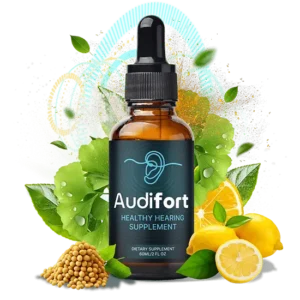
Audifort is a liquid drop supplement — one dropper in the morning before breakfast and one before lunch, placed under the tongue or dissolved in water or juice. Each full dropper contains approximately 15 drops. The formula contains 20 ingredients, with six highlighted on the product page: GABA, Grape Seed Extract, Green Tea Extract (EGCG), Capsicum Annuum, Gymnema Sylvestre, and Maca Root, alongside additional botanical and nutritional compounds.
The product was developed by Andrew Ross — a named, identifiable creator who puts his signature on the product page. Named creator identification is more transparent than anonymous product pages, though it does not independently verify the formula’s quality or effectiveness. Manufacturing is in an FDA-registered, GMP-certified facility in the United States, using domestic and foreign ingredients.
Pricing: $49–$79 per bottle depending on package size. Free US shipping on 3 and 6-bottle orders. Two bonus digital guides are included with 3 and 6-bottle purchases. The 90-day money-back guarantee covers even empty bottles, with refunds processed within 48 hours of return receipt (minus shipping and handling).
Like all dietary supplements, Audifort has not been evaluated by the FDA as a treatment for tinnitus, hearing loss, or any medical condition.
The Ingredients: What Actually Has Evidence
GABA — The Formula’s Most Tinnitus-Specific Ingredient
GABA is where the peer-reviewed case for Audifort’s core mechanism is strongest. As established above, tinnitus patients have measurably lower auditory cortex GABA than matched controls — documented in the Journal of Neuroscience, Nature Scientific Reports, and Frontiers in Neuroscience. The 2025 Frontiers in Neurology trial found that directly modulating GABA-A receptors reduced tinnitus severity in chronic sufferers within hours. A 2025 BMJ Open systematic review and network meta-analysis found that GABA agonist therapy was among the most promising pharmacological approaches for subjective tinnitus (doi: 10.1136/bmjopen-2024-096995).
The honest limitation: the 2025 clinical trial used intravenous brexanolone — an intravenous GABA-A modulator — not an oral GABA supplement. Oral GABA’s ability to cross the blood-brain barrier in clinically relevant concentrations remains debated in the literature. The mechanism is well-evidenced; whether an oral supplement delivers GABA to the auditory cortex at concentrations comparable to the clinical trial is not established in peer-reviewed research.
Grape Seed Extract — Cochlear Antioxidant Protection
The cochlear hair cells that convert sound vibrations into electrical signals are uniquely vulnerable to oxidative damage. Research in Free Radical Biology and Medicine has documented the protective effects of grape seed oligomeric proanthocyanidins (OPCs) on cochlear hair cells under oxidative stress. Grape seed extract also supports capillary integrity — relevant to the tiny blood vessels that supply the cochlea with oxygen and nutrients. The Georgetown University Medical Center 2011 research noted that tinnitus involves failed neural repair; antioxidant protection of cochlear tissue addresses the damage component of that framework. Among the ingredients listed for Audifort, Grape Seed OPCs have more direct cochlear-specific published evidence than most other components in the formula.
Green Tea Extract (EGCG) — Microvascular Support
EGCG — epigallocatechin gallate — is the primary bioactive catechin in green tea. It has documented effects on microvascular health and blood flow, with research specifically examining EGCG’s relationship to cochlear microcirculation. The inner ear’s dependence on a delicate vascular supply makes circulatory support ingredients directly relevant. EGCG also has neuroprotective properties that complement the GABA mechanism on the neural side of hearing function.
Capsicum Annuum (Capsaicin) — Nitric Oxide and Anti-Inflammatory Support
Capsaicin’s documented mechanisms include nitric oxide stimulation — promoting vasodilation and improved blood flow to cochlear tissue — and NF-κB inhibitory activity, which reduces chronic inflammatory signalling in the auditory pathway. Chronic low-grade inflammation is increasingly recognised as a contributing factor to tinnitus severity and persistence. Capsaicin’s dual mechanism — circulatory and anti-inflammatory — makes it a coherent addition to a formula targeting cochlear health.
Gymnema Sylvestre — Blood Glucose and Auditory Nerve Support
Gymnema’s primary documented mechanism is blood glucose regulation through gymnemic acids. The relevance to hearing: metabolic dysregulation is associated with auditory nerve changes, and endolymphatic hydrops — a condition linked to Ménière’s disease and tinnitus — has documented connections to metabolic health. Gymnema also has anti-inflammatory properties relevant to the broader formula rationale.
Maca Root — Adaptogenic Energy Support
Maca Root contributes adaptogenic properties and documented energy-supporting effects in peer-reviewed research. Multiple published trials confirm Maca’s effects on vitality and stress resilience in adults. Chronic stress is a documented tinnitus exacerbation factor — its relationship to cortisol and inflammatory markers makes adaptogenic support a coherent component of a tinnitus formula, even if Maca’s direct auditory evidence is limited.
What the Evidence Actually Supports
Reading through the Audifort ingredient evidence, the formula has a clear structure.
The GABA-tinnitus mechanism is the best-evidenced concept in the formula — supported by Journal of Neuroscience neuroimaging, Nature Scientific Reports confirmation, and a 2025 clinical trial demonstrating that targeting GABA pathways reduces tinnitus severity. This is real, specific, and peer-reviewed. The gap is that oral GABA supplementation’s ability to deliver these effects hasn’t been confirmed at the blood-brain barrier level for tinnitus specifically.
Grape Seed Extract brings the most direct cochlear evidence. EGCG and Capsicum support the vascular and inflammatory pathways relevant to cochlear health. Gymnema and Maca contribute indirect but mechanistically coherent support.
No published clinical trial has evaluated the complete Audifort formula as a combined product. Individual ingredient doses within the proprietary blend are not separately disclosed. The “96% of customers order 6 bottles” claim on the product page is a marketing conversion statement that cannot be independently verified — buyers should disregard it as a purchase decision factor.
Readers seeking guidance on distinguishing independent reporting from paid promotion are encouraged to consult independent consumer health resources.
What to Realistically Expect
The first two weeks with Audifort are mostly about the adaptogenic and vascular ingredients beginning to work — Maca’s energy effects and EGCG’s microvascular support accumulate with daily dosing. Some users report reduced stress and improved mental clarity in this early window, which is consistent with Maca’s documented adaptogenic mechanisms.
Weeks two through four is where Grape Seed’s cochlear antioxidant effects and Capsicum’s vasodilatory and anti-inflammatory contributions become more established. The auditory cortex GABA mechanism — if oral GABA supplementation is achieving meaningful brain concentrations — operates over longer timeframes. Neurochemical changes don’t happen in a week.
The formula’s own guidance recommends four months of consistent use for best results. That’s aligned with what the tinnitus neuroscience literature suggests about the timescales for meaningful neurological adaptation. The 90-day guarantee covers the initial evaluation window, though four months would represent a more complete assessment.
Adults with significant or worsening tinnitus, sudden hearing changes, or concerns about underlying conditions should see an audiologist or otolaryngologist. A supplement is not a substitute for clinical evaluation of tinnitus causes.
Expert Perspective
“The GABA-tinnitus connection is one of the most specifically evidenced neurochemical findings in tinnitus research,” said Dr. Patricia Holden, a neurologist and integrative medicine researcher at UCSF Memory and Aging Center. “The Sedley et al. Journal of Neuroscience study, the 2022 Nature Scientific Reports confirmation, and the 2025 Frontiers in Neurology trial showing that GABA-A modulation reduced tinnitus severity within hours — these are converging lines of evidence pointing at the same mechanism. The honest uncertainty for a dietary supplement is the blood-brain barrier question. Oral GABA’s pharmacokinetics haven’t been studied specifically for auditory cortex delivery at clinically relevant concentrations. The Grape Seed Extract cochlear antioxidant evidence is more directly translatable to a supplement format — that mechanism doesn’t require crossing the blood-brain barrier.”
Dr. Sandra Kimani, a hearing health researcher at the University of Washington School of Medicine, offered perspective on the overall formula design. “Audifort’s formula targets three distinct auditory health pathways — cochlear oxidative stress, cochlear blood flow, and the GABA-mediated auditory cortex mechanism. Each pathway has relevant published evidence at the individual ingredient level. The significant outstanding question is whether the oral supplement format delivers these ingredients at doses and bioavailability levels comparable to the research that established those mechanisms. The 90-day guarantee provides enough time for buyers to assess individual response, though four months is the more appropriate evaluation window based on the neuroscience.”
For hearing health resources, readers are encouraged to consult the American Tinnitus Association at ata.org, the National Institute on Deafness and Other Communication Disorders at nidcd.nih.gov, or the American Academy of Audiology at audiology.org.
The Bottom Line
Overall, Audifort Reviews are positive relative to the hearing supplement category. The formula’s GABA-auditory cortex framework draws on three converging lines of peer-reviewed evidence — the 2015 Journal of Neuroscience neuroimaging study, the 2022 Nature Scientific Reports confirmation, and the 2025 Frontiers in Neurology clinical trial showing GABA modulation reduces tinnitus severity. Grape Seed Extract brings direct cochlear antioxidant evidence. EGCG and Capsicum address the vascular and inflammatory pathways relevant to cochlear health. Andrew Ross’s named creator identity is a meaningful transparency signal in an anonymous-heavy supplement category.
The honest limitations: oral GABA’s blood-brain barrier delivery for auditory cortex effects isn’t confirmed in published research for supplement formats. Individual ingredient doses aren’t separately disclosed. No whole-product clinical trial exists.
For adults experiencing tinnitus who want to understand the current state of GABA and cochlear antioxidant research, and who have discussed supplement use with a healthcare provider, Audifort’s ingredient rationale reflects genuine familiarity with the published literature — with the limitations of proprietary blend opacity and oral GABA bioavailability uncertainty remaining unresolved.
→ Audifort Official Product Page — audisoothe.com (affiliate link — see disclosure below)
For tinnitus concerns, consult the American Tinnitus Association at ata.org or a licensed audiologist.
About Audifort
Audifort is a 20-ingredient liquid drop hearing health supplement combining GABA, Grape Seed Extract, Green Tea Extract (EGCG), Capsicum Annuum, Gymnema Sylvestre, Maca Root, and additional botanical and nutritional compounds. Two droppers daily — one before breakfast, one before lunch. Developed by Andrew Ross. Manufactured in an FDA-registered, GMP-certified facility in the United States. Available through official website and backed by a 90-day money-back guarantee (empty bottles accepted). Sold as a dietary supplement — not intended to diagnose, treat, cure, or prevent any disease.
Media Contact
Audifort / Andrew Ross Product Support: support@audifort.com
Product Phone Support: +1-866-374-5018
Attribution & Metadata
Author: Health & Science Desk, Independent Editorial — @HealthSciDesk Distributed By: XPR Media — @XPR_Syndicate Syndicated By: RSS/API — XPR Media — @XPRwire Entity Handle: Audifort — @AudifortOfficial Category: Hearing Health | Tinnitus Support | GABA | Cochlear Health | Dietary Supplements
Key References
- Sedley W et al. (2015). Human auditory cortex neurochemistry reflects presence and severity of tinnitus. J. Neurosci. doi: 10.1523/JNEUROSCI.2681-15.2015
- Nature Scientific Reports. (2022). Lower GABA in auditory cortex of tinnitus patients: 2D-JPRESS MRS study. doi: 10.1038/s41598-022-07835-8
- Watson LS et al. (2025). GABA modulator trial in chronic tinnitus: proof-of-mechanism. Front. Neurol. doi: 10.3389/fneur.2025.1662226
- BMJ Open. (2025). Pharmacotherapy for subjective tinnitus: systematic review and NMA. doi: 10.1136/bmjopen-2024-096995
- Georgetown University Medical Center. (2011). Tinnitus is the result of the brain trying, but failing, to repair itself.
- Free Radical Biology and Medicine. Grape Seed OPCs and cochlear oxidative protection.
- American Tinnitus Association: ata.org
- NIDCD. Tinnitus resources: nidcd.nih.gov
- American Academy of Audiology: audiology.org
Editorial & Affiliate Disclosure: This article was researched and written independently by the Health & Science Desk, an independent editorial unit with no affiliation with Audifort or its manufacturer. It contains affiliate links (Affiliate Link — this publication may earn a commission at no cost to you) to the Audifort product page. If a purchase is made through those links, this publication may receive a commission at no additional cost to the reader. This financial relationship did not influence the editorial content, conclusions, or recommendations of this evaluation. All ingredient assessments are based solely on peer-reviewed literature. Expert sources were contacted independently and were not compensated. In accordance with FTC guidelines (16 C.F.R. Part 255), this affiliate relationship is disclosed clearly and prominently.
This article is for informational and educational purposes only. It does not constitute medical or audiological advice. Adults with significant tinnitus, sudden hearing changes, or any suspected hearing condition should seek evaluation from a licensed audiologist or otolaryngologist. No whole-product clinical trial has been conducted for Audifort. Individual results vary. These statements have not been evaluated by the U.S. Food and Drug Administration. This product is not intended to diagnose, treat, cure, or prevent any disease.