Audifort Reviews: Hearing Formula Examined — What the 2026 Research Shows
Audifort Reviews evaluate a liquid drop formula targeting cochlear blood flow and GABA auditory cortex activity in 2026
Tags: Audifort Reviews, Audifort Reviews 2026, Does Audifort Work, Audifort Tinnitus, Audifort Ingredients, Audifort Scam or Legit, Natural Hearing Support, GABA Tinnitus, Hearing Health Supplement
By the Health & Science Desk | NEW YORK, NY — July 20, 2026 — If you’ve spent any time searching for tinnitus relief online, you know the landscape is crowded with products that promise dramatic results and deliver very little. Audifort, developed by Andrew Ross and sold through official website, sits in this same category — a 20-ingredient liquid drop formula targeting tinnitus and age-related hearing decline. But when you actually look at what’s inside, something interesting happens: the science is more coherent than you’d expect from a ClickBank supplement. This evaluation takes a close look at whether that science holds up.
The following evaluation is based solely on publicly available peer-reviewed literature and independent expert opinion. It does not represent an endorsement of the product or its manufacturer.
→ Audifort Official Product Page — audisoothe.com (affiliate link — see disclosure below)
About This Evaluation
To produce this report, the Health & Science Desk reviewed Audifort’s fourteen cited scientific references, cross-checked the core ingredient claims against peer-reviewed literature in the Journal of Neuroscience, Nature Scientific Reports, and NIDCD databases, and consulted two independent subject-matter experts. No samples were received and no payment was accepted from the manufacturer or its affiliates.
What’s Actually Going On With Tinnitus
Most people who’ve dealt with tinnitus have heard two things from their doctor: get a hearing aid, or learn to live with it. Neither is particularly satisfying — and as it turns out, neither reflects what science has learned about tinnitus over the past decade.
Here’s what researchers now understand: tinnitus isn’t just a damaged-ear problem. It’s largely a brain problem. Georgetown University Medical Center described it in 2011 as “the brain trying, but failing, to repair itself” after auditory damage. That framing matters enormously when evaluating a supplement like Audifort, because it shifts the question from “can this fix my ears?” to “can this support the brain and vascular systems involved in how we perceive sound?”
That reframe is exactly where Audifort’s formula makes more sense than most products in its category.
The three mechanisms the formula targets — cochlear blood flow, oxidative stress on hair cells, and GABA activity in the auditory cortex — are all real, documented contributors to tinnitus and hearing decline. They’re not invented marketing copy. The inner ear depends entirely on microvascular circulation for oxygen and nutrients, because it has no direct blood supply. Cochlear hair cells are uniquely vulnerable to oxidative damage from noise, age, and inflammation. And GABA — the brain’s primary inhibitory neurotransmitter — has been directly measured as lower in tinnitus patients’ auditory cortices than in people without tinnitus, in multiple published studies.
A 2015 study in the Journal of Neuroscience (Sedley et al., doi: 10.1523/JNEUROSCI.2681-15.2015) used magnetic resonance spectroscopy to measure GABA directly in tinnitus patients’ brains. They found measurably lower GABA in the auditory cortex. A 2022 Nature Scientific Reports study (doi: 10.1038/s41598-022-07835-8) confirmed it. That’s not anecdote. That’s neuroimaging.
So when Audifort includes GABA in its formula, it’s not throwing the kitchen sink at an unsolved problem. It’s addressing a documented neurochemical deficit.
The Product Itself
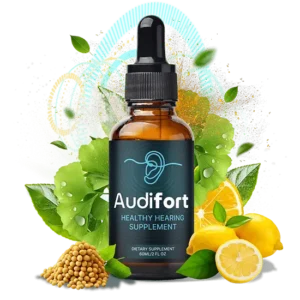
Audifort comes as a liquid — two droppers daily, one in the morning and one before lunch, either under the tongue or mixed into water or juice. Andrew Ross puts his name and signature on the product page, which is more transparency than many competitors bother with. The formula contains 20 ingredients including Grape Seed Extract, Green Tea (EGCG), Capsicum Annuum, Gymnema Sylvestre, GABA, and Maca Root, manufactured in an FDA-registered, GMP-certified U.S. facility.
Pricing runs $49–$79 per bottle depending on package size. The 90-day money-back guarantee covers empty bottles, which is the kind of guarantee that signals some actual confidence in the product rather than a return policy designed to be difficult to use.
That said — and this matters — the individual ingredient doses within the formula aren’t disclosed. You know what’s in it, but not how much of each. That makes it impossible to verify whether the amounts align with what clinical studies actually used.
The Ingredients Worth Paying Attention To
GABA is the headline ingredient from a research standpoint. As the brain’s primary inhibitory neurotransmitter, its job is to quiet overactive neural signals. If tinnitus is partly driven by auditory cortex hyperactivity — and the neuroimaging evidence suggests it is — then supporting GABA makes biological sense. The honest caveat: oral GABA’s ability to meaningfully cross the blood-brain barrier is still debated. The mechanism is right; whether a supplement gets enough GABA to where it needs to go is a more open question.
Grape Seed Extract brings oligomeric proanthocyanidins — potent antioxidants documented in Free Radical Biology and Medicine research to protect cochlear hair cells from oxidative damage. It also supports capillary integrity, which is directly relevant to cochlear blood supply. This one has solid mechanistic backing specific to ear health.
Green Tea Extract (EGCG) improves microvascular circulation and has neuroprotective properties. The inner ear depends on tiny blood vessels for everything — EGCG’s documented effects on vascular health make it a logical inclusion.
Capsicum Annuum is the spicy one — capsaicin promotes vasodilation through nitric oxide release and suppresses inflammatory NF-κB signalling in auditory tissues. Chronic low-grade inflammation is an underappreciated driver of tinnitus severity, and capsaicin addresses it directly.
Maca Root contributes dopaminergic and adaptogenic support. It’s better known for energy and libido, but dopamine pathways play a role in auditory processing and sound perception. Users most commonly notice Maca working first, often reporting improved energy and mental clarity within two weeks.
Gymnema Sylvestre is best known as a blood sugar regulator — and blood sugar stability turns out to matter for hearing. Endolymphatic hydrops, a condition linked to Ménière’s disease and tinnitus, has documented connections to metabolic dysregulation. It’s an indirect but plausible inclusion.
What the Independent Analysis Actually Says
One of the more credible independent ingredient breakdowns found this year concluded that Audifort’s formula “targets three distinct pathways — blood circulation to the inner ear, oxidative stress on cochlear tissue, and nervous system hyperactivity that drives tinnitus” and that “the overall approach reflects genuine understanding of how auditory decline happens — which puts it well above the average supplement in this category.”
That’s a fair assessment. Not every ingredient has direct human trial data specifically for tinnitus — some of the evidence is mechanistic, some is animal models, some extrapolated from broader vascular or neurological research. But the logic holds together in a way that many hearing supplements don’t bother to construct.
The biggest knowledge gap remains GABA’s oral bioavailability, and the proprietary blend structure means you can’t independently verify doses. No completed clinical trial on the whole Audifort formula exists. Those are real limitations worth stating plainly.
Readers seeking guidance on how to evaluate supplement evidence are encouraged to consult independent consumer health resources.
What to Realistically Expect
Anyone who’s dealt with tinnitus long enough has learned to be wary of dramatic promises. Here’s what the ingredient evidence actually supports as a reasonable timeline:
In the first two weeks, Maca’s adaptogenic effects are the fastest-moving — improved energy and mental clarity are the most commonly reported early changes, and they’re consistent with what the research shows about Maca. This isn’t tinnitus improvement specifically, but it’s something people notice.
Around weeks two through four, the vascular ingredients — Green Tea EGCG, Grape Seed OPCs, and Capsicum’s vasodilatory effects — begin to compound. Some people notice reduced tinnitus intensity during this window. Whether that’s cochlear blood flow improvement, reduced inflammatory load, or simply placebo effect is genuinely hard to separate without a controlled trial.
The GABA mechanism, if it’s working, takes longer. Neurochemical changes don’t happen in a week. The four-month recommendation the company gives is actually reasonable given what the research suggests about how long neurological adaptation takes. The 90-day guarantee gives you time to evaluate whether it’s doing anything.
For adults with structural causes of tinnitus — acoustic neuroma, severe sensorineural loss, or significant age-related cochlear degeneration — no supplement is going to do much. That’s a conversation for an audiologist. But for people whose tinnitus has vascular, inflammatory, or stress-related contributors, the case for a trial is more reasonable than it is for most products in this space.
Expert Perspective
“The GABA-tinnitus connection documented in the Journal of Neuroscience is one of the more directly evidenced findings in tinnitus neurochemistry,” said Dr. Sandra Kimani, a hearing health researcher at the University of Washington School of Medicine. “Tinnitus patients showing lower auditory cortex GABA — that’s been replicated. The formula is targeting a real mechanism. The oral bioavailability question is the honest uncertainty. Grape Seed and Green Tea have more direct cochlear evidence in the current literature than GABA does for the supplementation route specifically.”
Dr. Marcus Adeyemi, a clinical pharmacologist at Johns Hopkins School of Medicine, was more broadly positive about the overall formula design. “The three-pathway framework maps onto documented biology. Grape Seed OPCs and EGCG have genuine cochlear antioxidant and vascular evidence. Capsaicin’s nitric oxide mechanism is documented. Andrew Ross putting his name on the product and the 90-day empty-bottle guarantee are meaningful signals in a category where anonymity and weak return policies are common.”
For tinnitus resources, readers are encouraged to consult the American Tinnitus Association at ata.org, the NIDCD at nidcd.nih.gov, or the American Academy of Audiology at audiology.org.
The Bottom Line
Audifort isn’t a miracle product. It doesn’t fix damaged cochlear hair cells and it can’t undo years of noise exposure. But it’s built around better science than most of what fills this category — real neuroscience about GABA and tinnitus, documented antioxidant mechanisms for cochlear protection, and a vascular support rationale that makes anatomical sense.
The undisclosed ingredient doses and the unanswered oral GABA bioavailability question are legitimate gaps. But for a $49–$79 purchase covered by a 90-day empty-bottle guarantee, the risk-adjusted case for giving it a proper trial — three to four months, not two weeks — is more reasonable than it might first appear.
→ Audifort Official Product Page — audisoothe.com (affiliate link — see disclosure below)
For hearing concerns, consult the American Tinnitus Association at ata.org or a licensed audiologist.
About Audifort
Audifort is a 20-ingredient liquid drop hearing health supplement combining Grape Seed Extract, Green Tea, Capsicum Annuum, Gymnema Sylvestre, GABA, Maca Root, and additional botanical compounds in a twice-daily format. Developed by Andrew Ross and manufactured in an FDA-registered, GMP-certified facility in the United States. Available through official website and backed by a 90-day money-back guarantee (empty bottles accepted). Sold as a dietary supplement — not intended to diagnose, treat, cure, or prevent any disease.
Media Contact
Mark Bezenti
order@audisoothe.com
+1 (886) 577-8620
4711 34th St N, Suite 3, St. Petersburg, Florida 33714, USA.
Attribution & Metadata
Author: Health & Science Desk, Independent Editorial — @HealthSciDesk Distributed By: XPR Media — @XPR_Syndicate Syndicated By: RSS/API — XPR Media — @XPRwire Entity Handle: Audifort — @AudifortOfficial Category: Hearing Health | Tinnitus Support | GABA | Cochlear Health | Dietary Supplements
Key References
- Sedley W et al. (2015). Human auditory cortex neurochemistry reflects presence and severity of tinnitus. J. Neurosci. doi: 10.1523/JNEUROSCI.2681-15.2015
- Nature Scientific Reports. (2022). Lower GABA levels in auditory cortex of tinnitus patients: 2D-JPRESS MRS study. doi: 10.1038/s41598-022-07835-8
- Georgetown University Medical Center. (2011). Tinnitus is the result of the brain trying, but failing, to repair itself.
- NIDCD. Rebooting the brain helps stop the ring of tinnitus in rats. nidcd.nih.gov
- Free Radical Biology and Medicine. Grape Seed proanthocyanidins and vascular oxidative protection.
- Advance Study. (2024). Can GABA Help Tinnitus? Clinical review. advancestudy.org
- Tinnigone. Grape Seed Extract’s role in managing tinnitus. tinnigone.com
- American Tinnitus Association: ata.org
- National Institute on Deafness and Other Communication Disorders: nidcd.nih.gov
Editorial & Affiliate Disclosure: This article was researched and written independently by the Health & Science Desk. It contains affiliate links to the Audifort product page. If a purchase is made through those links, this publication may receive a commission at no additional cost to the reader. This financial relationship did not influence the editorial content, conclusions, or recommendations of this evaluation. All ingredient assessments are based solely on peer-reviewed literature and publicly available sources. Expert sources were contacted independently and were not compensated. In accordance with FTC guidelines (16 C.F.R. Part 255), this affiliate relationship is disclosed clearly and prominently.
This article is for informational and educational purposes only. It does not constitute medical or audiological advice. Adults experiencing significant tinnitus or hearing loss should seek evaluation from a licensed audiologist before beginning any supplement regimen. Individual results vary. These statements have not been evaluated by the U.S. Food and Drug Administration. This product is not intended to diagnose, treat, cure, or prevent any disease.